
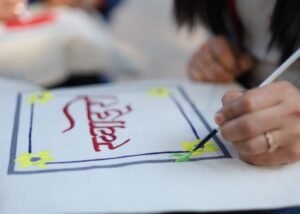
A six-year-old today learns to swipe before they learn to write.
Screens are replacing notebooks. Typed assignments are becoming the norm. Digital signatures have replaced handwritten ones. And somewhere in this fast transition — quietly, almost silently — the human act of writing is fading.
Technology is not the enemy. But when convenience becomes the default, we risk losing a foundational skill that has shaped cognition, communication, culture, and character for generations:
The ability to write — slowly, intentionally, by hand.
This is not merely about nostalgia. It is about what we may lose if we don’t protect it.
Handwriting Is a Cognitive Foundation — Not Just a Skill
Handwriting is often seen as a simple physical act. Yet research shows that writing by hand:
- Activates key areas of the brain
- Strengthens memory, comprehension, and language
- Builds patience, discipline, and attention
- Supports emotional regulation
- Develops fine motor intelligence
Typing is transactional.
Writing is transformational.
When a learner forms each letter stroke-by-stroke, their brain engages deeply — processing, understanding, and remembering.
This is not just handwriting.
This is learning.
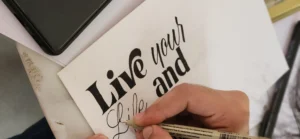
Calligraphy: Where Writing Evolves Into Awareness
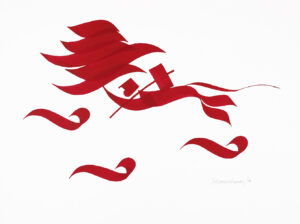
Calligraphy elevates writing into presence. In calligraphy:
- Strokes carry rhythm
- Curves reflect intention
- Space reflects breath
- Silence becomes part of the form
- It teaches us:
- Precision
- Balance
- Focus
- Patience
- Aesthetic judgment
In a world driven by speed, noise, and instant gratification — calligraphy invites stillness.
It becomes a practice of returning to oneself.
Sometimes, it becomes the first time a person hears their own quiet.
A Turning Point in My Journey
Like many, I began calligraphy as a hobby — something beautiful, something personal.
And I still remember the early days.
Ink smudged. Letters misbehaved. My hand resisted the rhythm.
Yet something felt right. Something felt familiar — as if my hands were learning what my heart already knew.
Over time, I realised:
Calligraphy is soulful.
It is for anyone seeking connection — to silence, to intention, to rhythm, and even to the universe.
It becomes meditative. You don’t just write — you become present.
Early in my journey, I saw a gap:
Calligraphy was often taught as imitation — copying a style, tracing forms, repeating strokes without understanding the foundation behind them.
But when calligraphy is learned with method, technique, and intention, something powerful shifts:
You stop copying — and start understanding.
Calligraphy becomes a process:
learning → observing → refining → expressing.
In that shift, handwriting becomes something more.
It becomes awareness in motion.
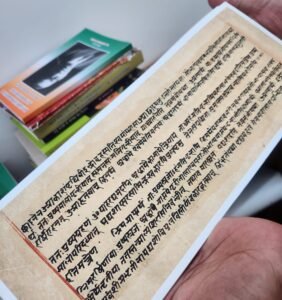
Why This Matters to India
India is a civilization written, carved, and preserved by hand — in scripts such as:
- Devanagari
- Urdu Nastaliq
- Gurmukhi
- Bengali
- Tamil
- Malayalam
- Kannada
- Modi
- Grantha
These are not just letter systems.
They are carriers of language, memory, identity, and worldview.
Yet today, many children can type fluently
but cannot write confidently — especially in their mother tongue.
So a question emerges — quietly, but urgently:
What happens to a culture when its handwriting disappears?
Calligraphy is not just an art.
It is cultural continuity.
The Role of Leadership: Creating Systems, Not Occasions
Passion starts movements — but systems sustain them.
If we want writing to remain integral in society, we must:
- Build curriculum frameworks
- Develop trained educators
- Create structured teaching methodologies
- Bridge tradition with modern tools
- Partner with museums, schools, and learning institutions
- Provide career pathways
- Create platforms for community and recognition
This is the work we are committed to at The Calligraphy Foundation.
Not to preserve calligraphy as a hobby —
but to build it as a skill, a discipline, and a professional ecosystem.
Because when artistry becomes education
and education becomes system
— a legacy begins.

Technology and Writing Can Coexist
This movement is not against digital evolution.
It is about balance.
Stylus writing, digital calligraphy apps, and hybrid learning models can support handwriting — but they must not replace the sensory intelligence and emotional connection of writing by hand.
A typed sentence can communicate.
A handwritten line can connect.
A Call to the Future
We stand at a turning point.
If we allow handwriting to fade, we lose:
- Cognitive strength
- Cultural identity
- Expressive individuality
- Quiet forms of mindfulness
But if we preserve it, teach it, and evolve it — we give future generations something that technology cannot replicate:
A sense of self.
Writing is not a disappearing skill —
it is an essential human act.
Bringing handwriting and calligraphy back into education is not about going backward.
It is about moving forward with consciousness.
The future of writing depends on what we do now.
And this movement belongs to all of us.
Do you believe handwriting should remain part of modern education?
Share your thoughts — your voice shapes what comes next.

Calligraphy is not handwriting.
It is awareness in motion — and a movement in progress.


1 thought on “The Writing Crisis: Why Calligraphy and Handwriting Still Matter in the Digital Age – By Raghunita Gupta — Founder, The Calligraphy Foundation”
A really good blog and me back again.